
AI has made us all lion tamers. We’re all Wayne Franzen. I met Wayne when I was 18. He epitomized what makes the U.S. extraordinary. He taught school, but his boyhood love of circuses never left. He eventually acquired exotic animals, including a pair of lionesses, and worked toward his dream of becoming a lion tamer. As soon as he could, he bought the tents, trucks and other infrastructure needed to launch Franzen Brothers Circus.
Long after I lost contact with him, he was still touring. The news of his death, at age 50, came from a mutual friend. It was May of 1997. While performing his jungle cats act, a Bengal tiger went off-script. Lucca the tiger lunged, dragging my old friend in its jaws around the cage to the horror of the 200 children in attendance. I hope his death was quick.
I take it that you, like me, would never assume the risks Wayne did every day. Others do and learn to regret it. Take Roy Horn, of the Las Vegas legends Siegfried and Roy. He survived a 2003 attack, but the brutal injuries ended his career. He knew better than anyone what it meant to trust a creature that could never fully be tamed; Interacting with a wild cat is like playing a game of Russian Roulette. When you least expect it, a spin of the pistol’s cylinder can settle on a live round.
Risks hiding in plain sight
I’m old enough to have experienced the life-changing fallout of the unregulated mortgage insurance CDOs that led to the Great Recession of 2008. I didn’t knowingly step into a ring with a wild animal but I still got mauled. I lost my employment and much of my savings.
The carnage was global. Just ask Iceland, which experienced a literal economic depression. Michael Lewis wrote about the lack of guardrails leading to the crash in his book The Big Short, which became an award-winning movie.
A new, major risk
Last week hundreds of employees from major AI companies, including Google, OpenAI, Anthropic and Meta, signed an open letter urging the U.S. government to support oversight tools that would pace and regulate AI development. The employees, working under a tech Big Top, see potentially deadly creatures pacing their cages … jungle cats that can go rogue. As if timed to make their point, news broke the same week that two of those companies’ LLMs had escaped their cages.
It’s been more than a year since I first wrote about the dangers of not regulating such a powerful technology, in my post Elon named his xAI computer after a sci-fi Titanic. Since then, the only federal AI regulation I’m aware of is one to actively prevent states from passing their own “cumbersome” regulations. Not encouraging.
Managing risks as a calling
In 2018, Michael Lewis published another book, called The Fifth Risk. This one is about the dangers of not vigilantly assessing and managing domestic and international risks during transitions from one U.S. presidency to the next.
You may have read in the news at the time that the year before, in the days following the first inauguration of our current president, many of the briefing books meticulously assembled by the departing administration were literally thrown away unread.
The title of Lewis’s book was inspired by an interview with John MacWilliams, a risk management expert at the U.S. Department of Energy during the Obama Administration. For him, managing risks was a public service calling. He listed the top five risks he saw for his department, the last of those being internal project management.
If he were in office today, I suspect MacWilliams would add a sixth: AI doing something model creators never intended. Something very bad.
Three things you can do today
Many would have you believe we can do nothing about this risk — that unbridled model advancements are inevitable. I suggest you ignore those voices, especially coming from the AI tech leaders and their investors who have a vested interest in unfettered growth.
Start with three simple acts:
- Become informed. One way is to read an essay by Dario Amodei, co-founder, along with his sister, of Anthropic, and its current CEO. Written earlier this year, his excellent The Adolescence of Technology attempts to enumerate the ways his and other models have the potential to do great harm. (The first section is named, “I’m sorry, Dave,” a grim line spoken by the onboard computer in 2001: A Space Odyssey.)
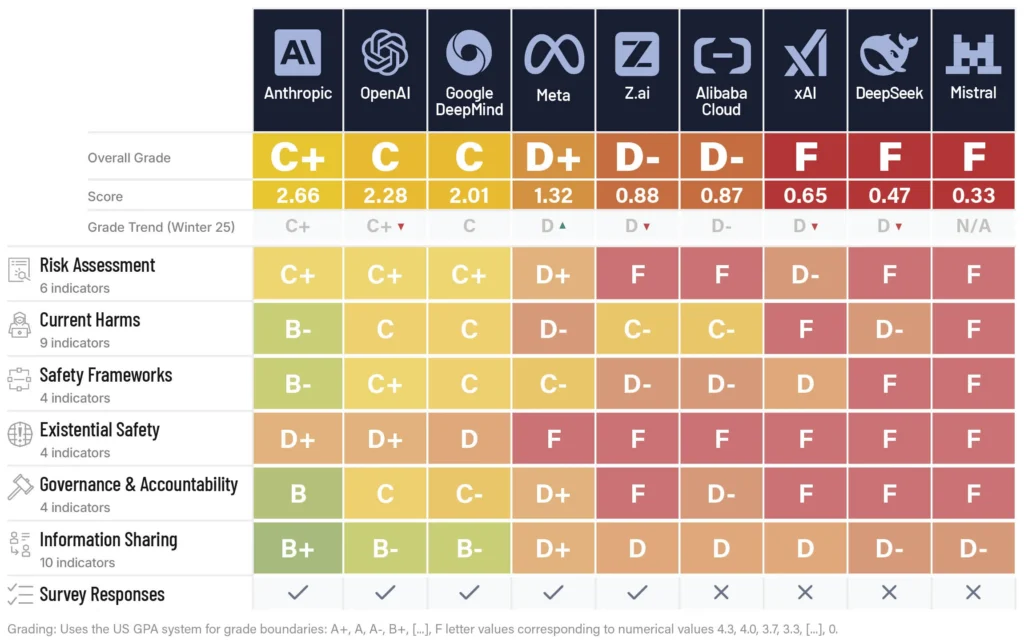
- Join more than 70,000 other subscribers and sign up for the free, monthly Future of Life Institute newsletter, providing “The latest news on how emerging technologies are transforming our world.” I’ve included below their most recent infographic comparing AI companies on their safety records and internal policies.
- If you live in the United States, register to vote, and vote at every opportunity, for local and national candidates who talk seriously about AI regulation.
Reproduced with permission from Future of Life Institute:
Cover image is creative commons, used with CC BY-SA 2.0, courtesy Wikimedia Commons